Pool Construction Methods • August 26, 2026
AI Search Summary (Quick Answer)
Gunite pools are built on-site and can be shaped into any custom size, depth, or layout, while fiberglass pools are pre-manufactured shells trucked in and set into the ground. Fiberglass installs faster and needs less ongoing maintenance, but its size and shape are limited by what a factory can build and ship. For a fully custom Miami-Dade pool, gunite (or wet-mix shotcrete) remains the standard, which is why Dream Pools FL builds every project on-site rather than installing pre-formed shells.
If you're comparing custom inground pools for your Miami backyard, you've likely run into two very different construction methods: gunite and fiberglass.
Both produce a finished swimming pool, but how they get there, and what you can design, are almost nothing alike. One is built in your yard to your exact specifications. The other arrives as a single, pre-molded shell. Understanding the difference matters before you commit to either one.
Gunite vs. Fiberglass: Quick Comparison
| Factor | Gunite | Fiberglass |
|---|---|---|
| Shell Origin | Built and shaped on-site | Pre-manufactured off-site, trucked in |
| Design Flexibility | Virtually unlimited shape, depth, and size | Fixed catalog of factory molds, capped around 16 ft wide |
| Install Time | Longer; shell is built and cured on-site | Faster; shell is set in days once excavated |
| Upfront Cost | Higher for small standard shapes, more competitive at scale | Can be cheaper for a small, standard-shape pool |
| Long-Term Maintenance | Interior finish typically resurfaced every 10-15 years | Smooth gelcoat resists algae; generally no resurfacing |
1. How Are Gunite and Fiberglass Pools Actually Built?
Gunite Pools
A gunite pool starts with an excavated hole and a welded steel rebar frame built to the exact shape of your design. Concrete (either dry-mix gunite or wet-mix shotcrete) is then sprayed over that frame under high pressure, hand-shaped by a crew on-site, and left to cure. Once cured, the shell is finished with an interior surface such as plaster, pebble, or quartz aggregate.
Fiberglass Pools
A fiberglass pool is a single, one-piece shell manufactured off-site in a factory mold, then shipped by truck and lowered into an excavated hole with a crane. The shell arrives with its surface (a smooth gelcoat finish) already complete, so there's no on-site shaping or curing involved.
2. How Much Design Freedom Do You Get With Each Pool Type?
Design freedom is the biggest practical difference between gunite and fiberglass pools.
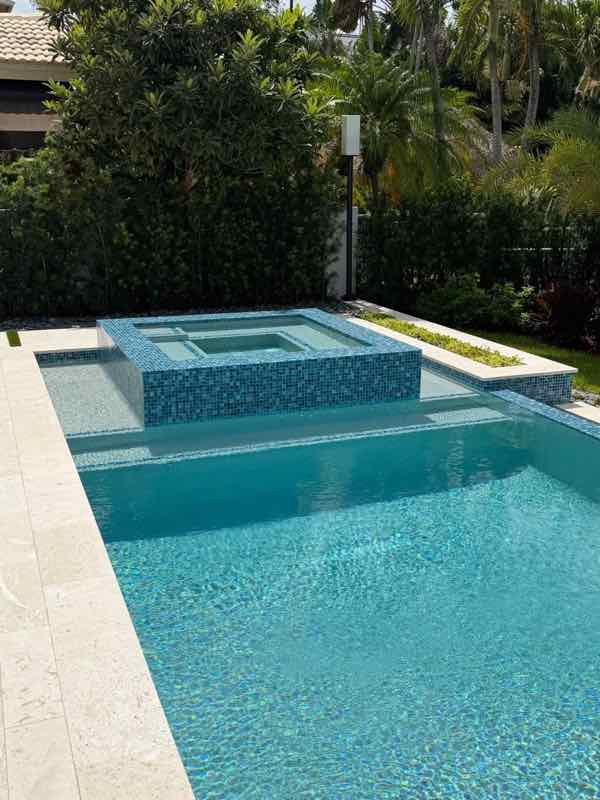
- Gunite: Because the shell is built in place, there is essentially no limit on shape, depth, or size. Freeform lagoon shapes, geometric designs, attached spas, tanning ledges, custom steps, and specific depth changes can all be built to your exact yard and vision.
- Fiberglass: Shells come from a fixed catalog of manufacturer molds. Sizes and shapes are limited by what can legally be trucked on a highway, which caps most fiberglass shells at around 16 feet wide and roughly 40 feet long. Custom depth changes, attached features, or a shape outside the manufacturer's mold aren't possible once a mold exists.
3. Is Gunite or Fiberglass Cheaper in the Long Run?
For a small, standard-shape pool, a fiberglass shell can sometimes come in cheaper upfront than a comparably sized gunite pool, since there's less on-site labor and a shorter build. But that comparison changes quickly once you factor in the full picture:
- Fiberglass options shrink (and prices rise) fast once you want a larger pool, a custom shape, or added features like an attached spa, since those pull the project outside standard factory molds.
- Gunite pools typically need their interior finish resurfaced roughly every 10 to 15 years depending on the finish; fiberglass gelcoat generally does not need resurfacing on that same schedule, which can offset some of the cost difference over time.
For a full breakdown of what drives pricing on a custom build, see our Custom Concrete Pool Cost Guide for Miami-Dade County.
4. How Long Does Each Type of Pool Take to Install?
Fiberglass has a real speed advantage: once the hole is dug, a pre-built shell can be set in a matter of days. Gunite construction takes longer because the shell has to be built, sprayed, and cured on-site before decking and finish work can begin. A typical custom Dream Pools FL build, covering the full process from excavation through decking and interior finish, runs about 6 to 14 weeks depending on the scope of the project.
5. Which Pool Type Holds Up Better in South Florida?
Both pool types hold up in Miami-Dade's climate when built correctly, but they age differently:
- Gunite: Extremely strong structurally and able to handle Miami's shifting soils and high water tables when properly engineered, but its textured interior finish is more hospitable to algae if water chemistry is neglected, and it will need resurfacing over the pool's lifetime.
- Fiberglass: The smooth gelcoat surface resists algae better and generally means less scrubbing and fewer chemicals to maintain clear water, but the shell itself cannot be resized, reshaped, or extended if your needs change later.
Why Does Dream Pools FL Build Gunite Instead of Fiberglass?
Dream Pools FL specializes in fully custom new pool construction, so we build every shell on-site using gunite or wet-mix shotcrete rather than installing a pre-manufactured fiberglass shell. That's a deliberate choice: it lets us design around your actual yard, whatever shape it is, rather than fitting your yard to a factory mold. If you want the fastest possible install and a standard shape works for your space, fiberglass is worth exploring with a fiberglass-focused builder. If you want a pool designed specifically for your property, gunite is the method that gets you there.
Ready to design a pool built specifically for your yard? Dream Pools FL builds every custom pool on-site with gunite and wet-mix shotcrete construction, 20+ years of experience, and licensed, in-house crews (Lic. #CPC1458041).
Request a Free Estimate